
Origins
Islam originated in the early 7th century CE in Mecca, located in the Arabian Peninsula. According to Islamic tradition, the Prophet Muhammad received revelations from God (Allah) via the angel Gabriel starting around 610 CE. Muhammad preached absolute monotheism (Tawhid) in a predominantly polytheistic society, advocating for social justice, ethical reform, and accountability. Following persecution in Mecca, Muhammad and his followers migrated to Medina in 622 CE (an event known as the Hijrah, marking the start of the Islamic calendar). By his death in 632 CE, Islam had united the Arabian Peninsula.
Articles of Faith (Iman)
Islamic theology is anchored in six foundational articles of belief:
- Belief in God (Allah): Absolute belief in the oneness, uniqueness, and supreme authority of God.
- Belief in Angels: Acceptance of unseen spiritual beings created by God to carry out His commands.
- Belief in Holy Books: Faith in divine scriptures as originally revealed, including the Torah, Gospel, Psalms, and the Quran as the final, unaltered word of God.
- Belief in Prophets & Messengers: Acceptance of God’s messengers sent to guide humanity, including Abraham, Moses, Jesus, and Muhammad as the final prophet.
- Belief in the Day of Judgment: Belief that all human beings will be resurrected and held accountable by God for their deeds.
- Belief in Divine Decree (Qadar): Acceptance that God has complete knowledge, control, and ultimate authority over everything that occurs in the universe.
These core beliefs complement the Five Pillars of Islam—the physical acts of worship: Declaration of Faith, Daily Prayer, Almsgiving, Fasting during Ramadan, and Pilgrimage to Mecca.
Geographic Presence & Strongholds
Islam is the world’s second-largest religion, with over 1.9 billion adherents globally.
- Key Regions: While often associated with the Middle East and North Africa (MENA), the vast majority of Muslims live in the Asia-Pacific region. Indonesia is home to the world’s largest Muslim population, followed closely by Pakistan, India, and Bangladesh.
- Reasons for Stronghold:
- Historical Trade & Sufism: In Southeast and South Asia, Islam spread rapidly through maritime trade networks, peaceful cultural integration, and the egalitarian appeals of Sufi spirituality rather than military conquest alone.
- Dynastic History: In the MENA region, Central Asia, and parts of Europe, centuries of governance under major Islamic empires (Umayyad, Abbasid, Ottoman, Mughal) established institutional, judicial, and cultural roots.
- Demographics: High fertility rates and strong intergenerational transmission of faith in predominantly Muslim-majority nations sustain its demographic growth.
Extremists vs. Moderates: Key Differences
| Dimension | Mainstream / Moderate Muslims | Extremists / Radicals (e.g., Takfiri/Jihadi Groups) |
| Religious Hermeneutics | Read texts in historical context; rely on consensus (Ijma), scholarship, and nuanced legal tradition (Fiqh). | Selective, literalist, and decontextualized readings of scripture to justify predetermined political aims. |
| Concept of Jihad | Interpret Jihad primarily as an internal spiritual struggle against self; armed struggle is strictly defensive, state-sanctioned, and bound by rules of engagement. | Frame Jihad exclusively as an offensive, mandatory military duty for individuals against non-believers and state regimes. |
| Treatment of Others | Emphasize peaceful coexistence, religious tolerance, and civic cooperation with non-Muslims and other Muslim sects. | Practice Takfir (declaring fellow Muslims apostates) and justify violence against non-Muslims, religious minorities, and dissenting Muslims. |
| Governance & Power | Support civic participation, rule of law, national sovereignty, or gradual reform within modern political systems. | Reject democratic and international norms entirely, seeking the immediate, violent overthrow of governments to establish a totalitarian caliphate. |
The symbols of Islam
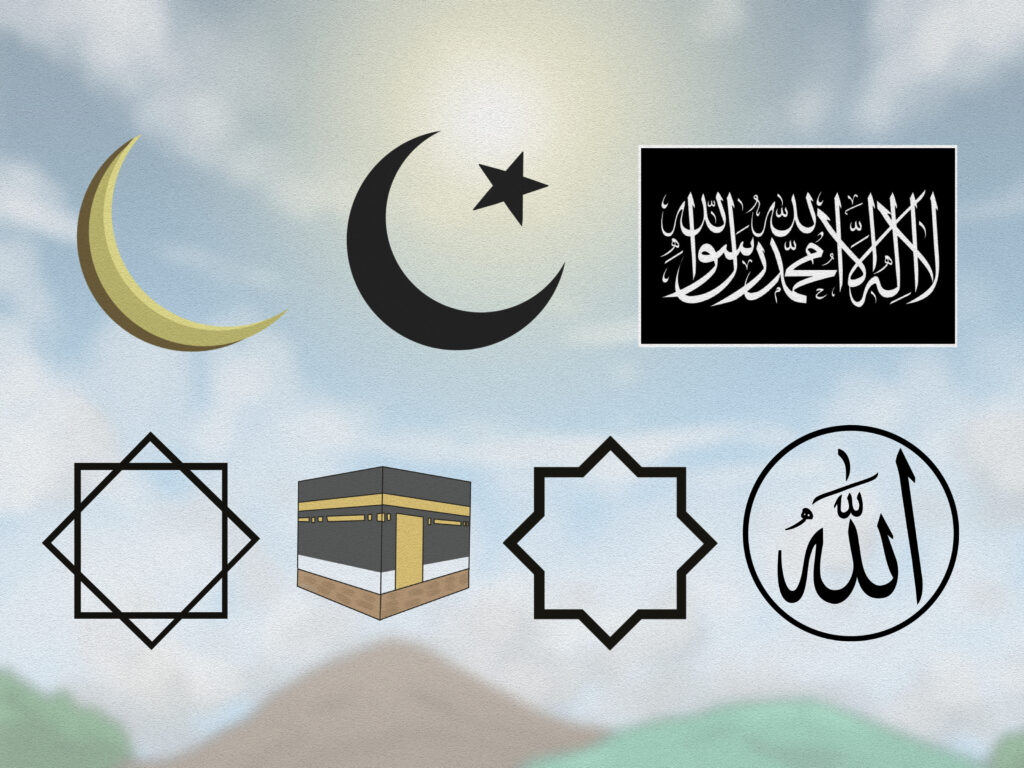
The key symbols associated with Islam carry historical, theological, and practical meanings:
1. Crescent Moon and Star (Hilal)
- Meaning & Origin:Though widely recognized as the primary visual symbol of Islam, the crescent and star pre-date Islam and were originally ancient Mediterranean and Central Asian emblems.It gained widespread Islamic association after being adopted by the Ottoman Empire as its military and state standard.
- Symbolism:In an Islamic context, the crescent moon highlights the lunar calendar (Hijri), which determines Islamic holy periods such as Ramadan and Hajj. The five points of the star are often interpreted as representing the Five Pillars of Islam.
2. The Shahada (Declaration of Faith)
- Meaning:Written in Arabic script (e.g., “La ilaha illallah, Muhammadur Rasulullah”), it translates to: “There is no god but Allah, and Muhammad is the messenger of Allah”.
- Symbolism:As the first pillar of Islam, it serves as the ultimate statement of absolute monotheism (Tawhid).It is frequently displayed on flags, banners, and sacred architecture as a direct expression of faith.
3. Calligraphy of “Allah” (ﷲ)
- Meaning:The stylized rendering of the Arabic word for God (Allah).
- Symbolism: Because traditional Islamic theology avoids figurative images of God or prophets to prevent idolatry, Arabic calligraphy evolved into the primary form of visual sacred art. Visualizing the name of God symbolizes divine presence, unity, and reverence.
4. The Kaaba
- Meaning:The black, cube-shaped structure located at the center of the Grand Mosque (Masjid al-Haram) in Mecca.
- Symbolism:Known as Bayt Allah (the House of God), it represents spiritual unity (Qibla)—the physical focal point toward which all Muslims worldwide turn during their daily prayers, as well as the center of the Hajj pilgrimage.
5. Rub el Hizb (The Eight-Pointed Star)
- Meaning:A geometric shape formed by two overlapping, rotated squares.
- Symbolism:Originally used in Quranic manuscripts as a navigational marker to divide the text into sections (Hizb) to facilitate memorization and recitation. In Islamic art and architecture, it symbolizes completeness, divine order, and balance.
6. Colors: Green, White, and Black
- Green: Traditionally associated with Islam because of references in the Quran describing the garments and gardens of Paradise. Historically used by the Prophet Muhammad’s family and early dynasties.
- Black & White:Represented by historical flags like the Black Standard (Al-Raya) used in early Islamic battles and expansion as administrative and military markers.
Customs and Practices of Islam
Islamic customs and behaviors guide daily life, family, hygiene, social interaction, and ethics. They are derived primarily from the Quran and the Sunnah (the practices and traditions of the Prophet Muhammad).
1. Daily Practices & Worship
- Five Daily Prayers (Salah): Muslims perform five obligatory prayers throughout the day (dawn, noon, mid-afternoon, sunset, and nightfall) facing the direction of the Kaaba in Mecca (Qibla).
- Ablution (Wudu): A ritual washing of the hands, mouth, nose, face, arms, head, and feet required before performing prayer or handling the Quran.
- Fasting (Sawm): Refraining from eating, drinking, smoking, and marital relations from dawn to sunset during the holy month of Ramadan to foster self-discipline and empathy for the less fortunate.
2. Dietary Rules (Halal and Haram)
- Permissible (Halal): Foods prepared according to Islamic guidelines, including meats slaughtered in the name of God (Dhabihah).
- Prohibited (Haram): Consumption of pork, blood, meat from carnivorous animals or animals not properly slaughtered, and intoxicants (alcohol and drugs).
3. Personal Hygiene & Grooming (Taharah)
- Cleanliness: High importance is placed on physical purity, including regular bathing, trimming nails, removing body hair, and keeping clothing clean.
- Etiquette of Hands: The right hand is used for eating, drinking, greeting, and handing objects to others, while the left hand is reserved for personal hygiene.
4. Greetings & Social Interactions
- The Islamic Greeting: Saying “As-salamu alaykum” (“Peace be upon you”) and responding with “Wa alaykumu as-salam” (“And upon you be peace”).
- Modesty (Haya): Expressed through humble behavior, speech, and attire. Both men and women are expected to dress modestly (e.g., covering private parts; for many women, wearing a headscarf/hijab).
- Respect for Elders & Neighbors: Fulfilling duties to parents, family members, and neighbors—regardless of their faith—is considered a major religious obligation.
5. Ethical & Financial Conduct
- Charity (Zakat and Sadaqah): Giving a fixed portion (typically 2.5%) of accumulated wealth annually to those in need (Zakat), as well as voluntary acts of charity (Sadaqah).
- Ethical Business: Prohibition of interest/usury (Riba), excessive uncertainty or gambling (Gharar), and dishonest business dealings.
6. Expressions of Intent
- Inshallah: Meaning “God willing,” said when discussing future plans or intentions.
- Alhamdulillah: Meaning “Praise be to God,” expressed when giving thanks or expressing contentment.
- Bismillah: Meaning “In the name of God,” recited before starting any action, such as eating or embarking on a journey.